
Maximizing Review Impact
Before getting too deep in the details here, let’s make sure your business is organized and prepared to benefit from reviews.
There are simply too many potential issues that can hold you back. If you don’t have these pieces in place, you may not get the expected results.
Reviews will have a much better impact after you have:
- A list of target keywords
- Competitor analysis and plan
- Proper website structure
- Optimized your GBP
- Optimized your website
Although you can, and should, continue to get reviews for your business, these primary local SEO tasks will help you maximize the impact of your review efforts.
Now, let’s look deeper at reviews themselves, and what variables matter when analyzing and acquiring reviews.
Factors that Impact Reviews
There are many different factors that account for how much impact your reviews will have on rankings.
Some are more obvious, like total number of reviews, but many of these factors are less obvious—but still very important for business rankings.
Here are the primary review factors:
- Total Number of Reviews
- Overall Review Score
- Review Velocity
- Length of Reviews
- Review Text
- Images in Reviews
- Reviewer Account Level
Every review factor on this list makes sense when you considering its impact on click-through-rate (CTR)—an important metric for ranking on Google.
Simply put, the more traffic, as a percentage, takes an action from your Google Maps listing—clicking to call, booking an appointment, or visiting your website—the higher your CTR will be.
As your CTR improves, Google will list your business higher in the search results.
For reviews, Google knows that each of these factors are important to the local customer journey—and CTR—which is why they improve rankings.
Let’s look at each of these factors in more depth.
Reviews: Total Number
It’s safe to say that the number of reviews is a pretty simple metric to understand. Customers are drawn to businesses with more reviews than competitors. Whether it’s 100 reviews compared to 10, or 10,000 reviews to 1,000—local SEO is always relative.
More reviews, more attention, more trust, higher CTR—all important factors in local SEO rankings.
Reviews: Overall Score
The next factor is your overall review score.
A business with a healthy total average score — around 4.5+ — will be more trustworthy to customers than those with lower numbers.
Getting into the 3.0’s or 2.0’s will make it very difficult for a business to rank.
Once again, low score, low trust, low CTR—which is why it’s important to keep your overall average review score as close to a 5.0 as you can get.
Review Velocity
Google favors fresh and recent activity. That’s what makes review velocity such an important metric for local businesses.
Review velocity is a simple calculation that shows you how many recent reviews your competitors are getting on average each month.
You’ll need to count up the total number of reviews each competitor has received over the last three months.
Then, find reviews velocity by dividing by three.
Total Reviews (Last 3 Months) / 3 = Review Velocity
Once you know this number, if you can outperform your competitors consistently, you’ll start to see a dramatic improvement in your Google Maps rankings.
Review Length (Character Count)
The number of characters in a review is another important measure of customer engagement.
If customers are consistently writing long reviews and praising your company, you must be doing something right—and Google will take notice.
When a customer writes a review, they get points from Google in their local account. This gives us some insight into how Google looks at review length.
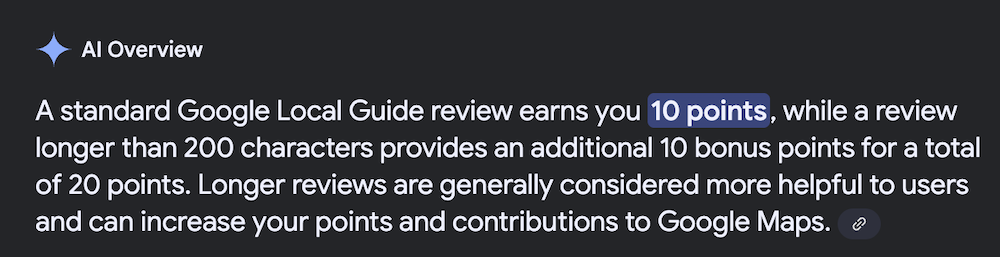
At 200 characters, Google gives an additional points bonus to the reviewer.
That means, if you can get customers to write minimum 200 characters in length, you’ll benefit.
Will it help if they are even longer? That’s really unknown. However, if you can get customers to happily write out their experience with your company and the services you offered them, they are unlikely to be shorter than this 200 character length.
Review Text — Keywords and Services
The content, or text, in a review is also important for Google to understand your business services, and helps boost rankings.
If a review for a plumbing company focusing on local SEO gets reviews talking about roofing, it’s going to be confusing for potential customers, and Google. Makes sense!
But, on the other hand, if you have hundreds of reviews talking about your plumbing services, this helps Google feel more confident showing your business to potential plumbing customers.
This is the same for location keywords too. Customers that mention their city in the review may help you improve rankings in those areas.
Lastly, this can be even more effective for niche services and less competitive terms—especially those you discovered through local keyword research. If a customer talks about your “trenchless plumbing” service, and few businesses are targeting this keyword, that may be all you need to boost your rankings for that specific keyword.
Potential customers love seeing stories from your past customers that describe what they are looking for, which is why the text in your reviews matters.
Review Images
When customers put images in reviews, this also has a positive impact.
That’s because, getting photos and adding them to a review takes extra effort—and Google knows this.
They are also very effective for attracting new customers.
Often, Google will push these reviews with images to the top of your business profile. This helps make your profile more visual and more enticing for potential customers.
Regularly adding images to your GBP can be helpful, but if you can get customers to put images in their reviews, you’ll see an even stronger rankings benefit from this.
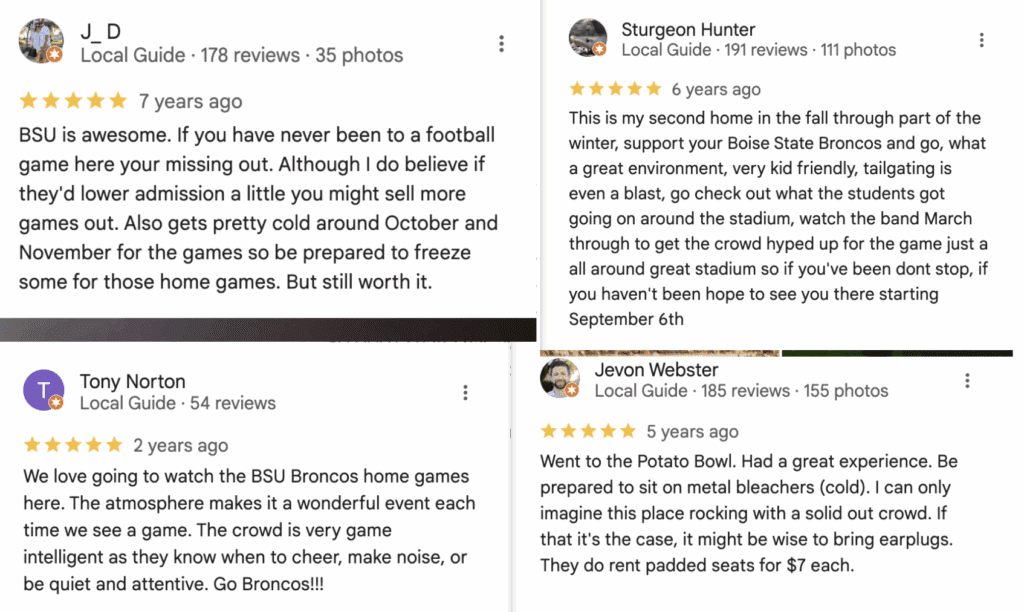
Reviews from Local Guides
The last variable relates to the account level giving the review.
Google accounts that have given a certain number of total reviews are called “Local Guides” accounts—and they carry more trust.
Many Local Guides are very serious about giving good, high-quality reviews that help out the community.
Getting reviews from Local Guide accounts will improve the overall trust of your profile and have a positive impact on your rankings.
This isn’t always something you can control. But, if you do a good job for customers consistently, you’re naturally acquire strong reviews from these trusted Local Guide accounts.
Local SEO: 200 Reviews
Now you have a pretty strong understanding of reviews and the factors that impact the strength of every review.
Take the time to talk to your customers and help them understand these important factors, so they can give your business better reviews.
Before ending this, let me show you a very interesting fact from a study on reviews.
“Businesses with a minimum of 200 reviews generate twice as much revenue.”
That means, if you want to put yourself in position to statistically double your revenue and beat competitors, you should set a goal to get 200 reviews.
This is crazy to me because, it’s so measurable!
It’s the line in the sand that separates the successful from the others.
Set a goal to get to that 200 mark.
And if you get 200 long, keyword rich reviews with images in them—you’re going to be far ahead of your competition.
That concludes this section, now let’s move on to our next important topic in this local SEO guide:
How to use popular tools to track leads, calls, and other important metrics.