


In local SEO, rankings factors provide the key tasks and actions you need to get more leads from Google Maps and Google Search.
Simply put, if you know what ranking factors matter the most, you’ll essentially have a roadmap to guide you to the top.
However, local SEO is much more difficult than traditional SEO because there are two algorithms that matter: Google Maps and Google Search (which is increasingly becoming a third with AI/LLM search tools).
Let’s look at the ranking factors for local SEO with regards to these two search channels—and see if we can learn more about what really matters.
Local SEO Rankings Factors

Now, before getting into the exact factors, let me give you some insights that have helped me dramatically.
#1 – Test Everything
It’s important to remember that all of these Google algorithms constantly fluctuate and change. You always need to have “strong opinions loosely held.” What works today may not work tomorrow—the game is ever changing.
Always be on your toes expecting changes, and contently test your ideas and theories with a method you can track and measure.
#2 – Don’t Invent
Like I said before in my three rules for local SEO, don’t invent—reverse engineer.
I personally do this by looking outside myself for helpful research and information.
This Whitespark survey of local SEO experts is a great tool to put certain ranking factors into a hierarchy.
It still needs to be tested, and shouldn’t be taken as fact, but it’s a really good starting place.
Now, what I am going to do is first give you the ranking factors, then separate them out between one-time, optimization, or more “hard-coded” ranking factors, and then the ongoing, more task oriented ones.
This way, you can build a list of one-time factors, and continuous tasks, and make a strong plan from that.
First up, Google Maps ranking factors, then after that we’ll look at Google Search.
Google Maps SEO Ranking Factors
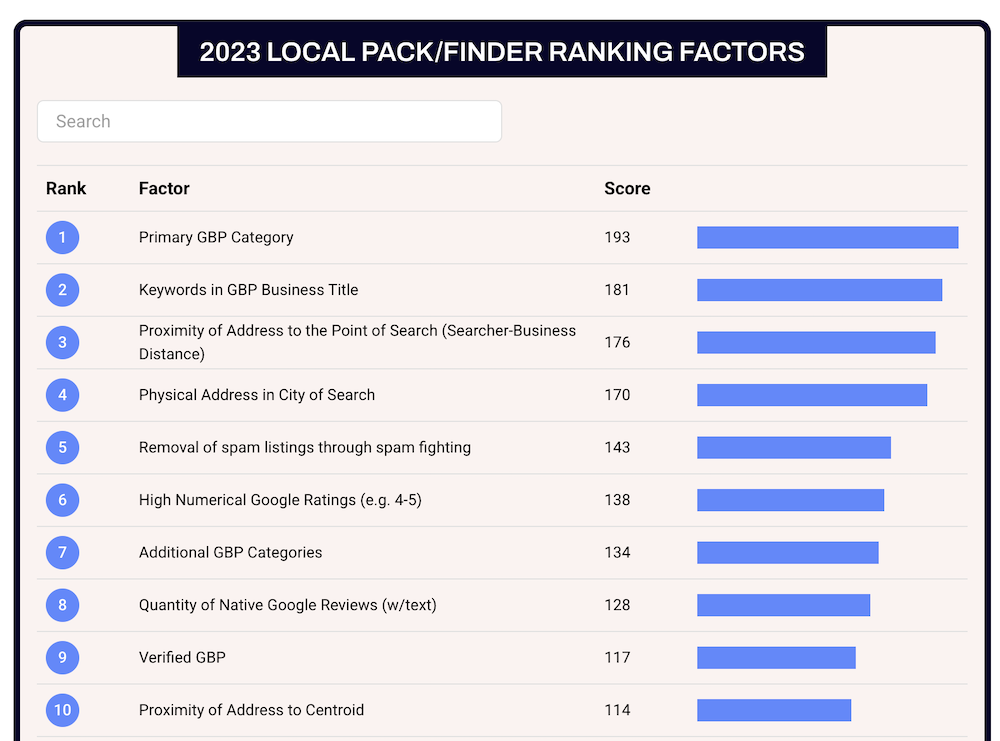
Google Maps SEO ranking factors are those tied to your Google Business Profile (GBP) and directly influence your rankings on Maps specifically.
Let’s start by looking simply at a list of the 15 Google Maps ranking factors:
- Primary Category
- Keywords in Business Name
- Proximity from Searcher
- Physical City Address
- Spam Fighting
- High Overall Average Rating Score
- Secondary GBP Categories
- Quantity of Reviews
- Verified Listing
- Proximity of Address to City Center
- Keywords in Landing Page Title
- Complete Google Profile
- Review Velocity
- Dedicated Service Pages
- Keywords on Landing Page Headers
These are really important to know. However, you’ll notice the majority of these are one time tasks, or hard-coded like your address—something that isn’t easy to change.
That’s why I think it’s important to break these up into two groups: Hard-coded optimization and ongoing tasks.
Google Business Profile — Hard-Coded Ranking Factors
Let’s start first with these more hard-coded ranking factors for Google Maps.
These are:
- Primary category
- Keywords in the business name
- Location of the searcher
- City business is located
- Secondary GBP categories
- Proximity to the center of the city
- Dedicated service pages on website
- Internal linking
- Keyword in headers on landing page
Now you can see why I use the words “hard-coded.” Some of these factors can be altered or optimized on your GBP to fit your needs and help improve your rankings. However, others are location based, and may require relocating to improve—which many business owners and SEOs will simply not be willing or able to do.
And even the adjustable fields are typically going to be a one time task.
Let’s run through these most important items from this list.
#1 — Primary Category
The category you choose is the most important ranking factor.
Trying to rank for a secondary category is much more difficult.
However, some categories are grouped together. Which means, it doesn’t matter much which you choose—they all operate as if they are the same.
For instance: HVAC contractor, Heating contractor, and Air conditioning contractor — all of these are considered the same by Google. You will see businesses from each of these categories ranking equally for each service related to these.
Similarly, Landscaper and Landscape designer rank for similar keywords—Google considers them to be the directly related.
However, this is uncommon. And it’s important to understand that ranking for services in your secondary category is much more difficult.
For example, a plumbing company with HVAC as a secondary category will struggle to rank for HVAC services against other HVAC companies using the designated primary category.
This doesn’t mean you cannot rank for secondary categories, but your primary category is the main driver of where you compete and rank.
#2 — Keywords in Your Business Name
Next up, keywords in your business name.
If your business contains specific keywords or terms that match keywords used by searchers, you’re going to benefit.
For instance, a business with “emergency plumber” in their name will often have priority over the ones who don’t when a potential customer searches for that exact term.
This is not 100% accurate all the time. However, it does tend to be a good rule of thumb and something to understand.
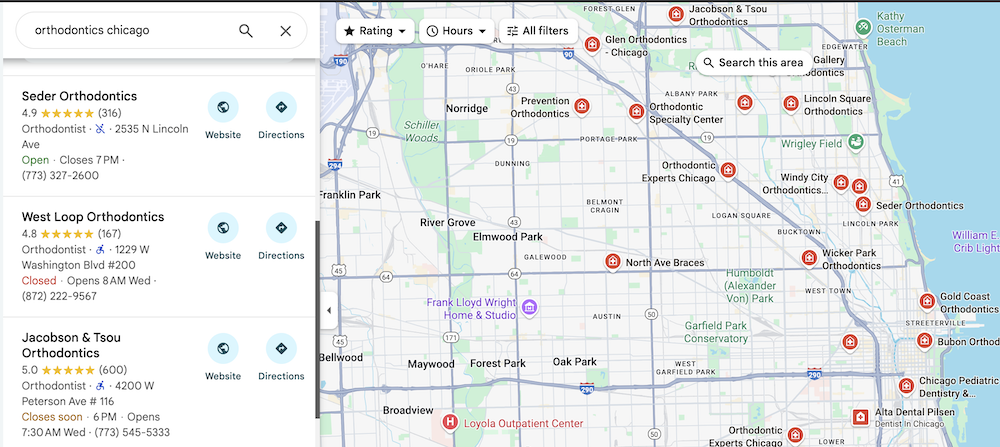
The above example looks at a search for “orthodontics” in the Chicago area.
The first 20-30 results all had the word “orthodontics” or some variation in their business name.
It’s always relative! But when you see the results showing up this way for your business services, it means you likely need to have these keywords in your name to compete.
This can also work in your favor—if you can find keywords that get search volume, and that your competitors aren’t targeting, this can be a big win for your business.
Please, remember that you cannot simply go change your business name on your GBP. That can get you suspended quickly. There is a proper approach to changing your business name, address, and other important information you need to be aware of before doing so.
Just understand the concept here, that the words in your business name carry weight—enough in fact to make them the second most important ranking factor on the list.
#3 — Location and Proximity
Let’s now lump a few of these together into what I’ll call — location.
The location your business is in makes a big difference.
First, the person searching—or how close you are to that person—plays a big part in where you show up on Maps. Thus, choosing a strong location close to potential customers, and away from big competitors, may be a smart choice.
But, the city your business is located in and your proximity to the center of the city are also ranking factors.
The city name matters. For instance, if you’re on the edge of Dallas, TX — but you have a Garland address — this can have a negative impact on search rankings.
This is not always something you can control, but it’s important to be aware of the effects your proximity and location will have on your rankings.
#4+ — Other Optimization Based GBP Ranking Factors
The above are the most important ranking factors to understand.
But, let’s quickly look at a few of the others on the list.
Secondary category — If you want to rank for something, make sure it’s in your primary or secondary category. Otherwise it’s really hard for Google to know you offer that service. Many secondary categories rank well, or have lower competition. So don’t miss this.
Website & GBP optimization — The rest of these factors are tied to website optimization and GBP optimization. Internal linking, service pages, keywords in your headers, all of these can help boost rankings.
Now, let’s look at ongoing tasks and actions that help you rank on Google Maps.
Ongoing Google Business Profile Activities and Rankings
Now, let’s move to the action items — or more regular tasks that are considered important ranking factors for local SEO on Google Maps.
They are:
- Removing spam listings (competitors and spam)
- Keeping a high overall Google review rating (ex. 4.0 to 5.0)
- High number of total reviews
- Number of recent reviews
- Backlinks to the domain
Basically, you have spam fighting which is explained in more detail here.
Then reviews—with three of our top five being reviews based—you can see why I am so big on reviews.
Lastly, backlinks are an important piece of ranking on Google Maps and can help boost you above close competitors.
Let’s look at each of these briefly.
Spam Fighting

Spam fighting simply means analyzing competitors on Google Maps, and using the “Suggest an edit” feature to help remove spam listings and keyword stuffing by companies breaking Google Terms of Service in your area.
The above image is an example of a *likely business using keyword stuffing in their name to get an advantage on Google Maps.
Spam fighting is a proactive tactic can help your business rank higher in your local market because it helps reduce or eliminate those who are bending or breaking the rules to improve their search strength.
By fighting against this manipulation, you’re better situated to get traffic and customers from Maps.
You can read more about spam fighting and other important recurring tasks in this article here.
Reviews
Since reviews are such a massive ranking factor for Google Maps, let’s look at the different parts of reviews that can help move the needle.
You can read more in-depth about reviews for local SEO in this article here. Otherwise I will cover the factors briefly.
This way, you can harness the full power of reviews and swing rankings into your favor.
- Overall review rating — The total average rating of all reviews based on number of stars.
- Total number of reviews — You have 1,000 — the other guy has 10 (pretty obvious).
- Review velocity — The average number of reviews per month, over the last 3-months.
- Review length — Number of reviews with over 200 character length.
- Images in reviews — Number of reviews with images in them from customers.
- Review content — How many reviews contain city or service keywords.
- Quick review responses — Is the business responding to reviews in a reasonable timeframe.
All of these factors have an impact on your reviews and helping your business rank.
I always ask myself, “What do customers want?”
That’s pretty much going to tell you what Google wants. All of these play in to giving customers more insight into your business.
It’s also harder to game or manipulate, and Google loves putting weight on effort that comes from outside the business—which in this case is customers and their willingness to share their experiences.
Backlinks
Lastly, although backlinks are not nearly as effective for Google Maps rankings as they are for local search, they can still be the difference that helps you outrank competitors.
Backlinks, especially quality backlinks, are difficult to get.
Strong backlinks can add up, help you rank on Maps and Search, and be an effective tool for boosting your brand awareness by showcasing your business on helpful articles or digital news media.
Get more in-depth information about backlinks in this article here.
With that, you have a pretty solid idea of the Google Maps ranking factors, and what you can do to influence your rankings on Google Maps.
But that’s not the end of rankings for local SEO. You have two algorithms at play. With that, let’s move to Google Search and rankings factors for your local area.
Google Local Search Ranking Factors
Now, let’s look at how to rank on Google Search.
This is a bit simpler because Google Search is simply based on traditional SEO factors—which is much easier to explain.
Yes, there is a list from our original source, but it matches up pretty well with my simple breakdown of Google Search.
Here is my explanation. For local Google Search rankings, the primary ranking factors are summed up as follows:
Content + Authority = Rankings
Authority is simply the benefit you get from quality backlinks.
Here is the list from our expert survey:
- Dedicated service pages (Targeted Content)
- Internal linking (Backlinks)
- Quality of inbound links (Backlinks)
- Geographic content (Targeted Content)
- Keywords in titles (Targeted Content)
You can see how similar they are.
Let’s look at these two primary ranking factors a bit closer.
Targeted Content
Rankings start with targeted content.
For instance, if you want to rank for plumbing keywords in your local city then you need to have content that targets those specific terms.
Once gain, if you only have content on your site about epoxy, but not plumbing, you’re going to struggle!
Targeted content is an important part of the “October Method” for local SEO, and tells Google WHAT you want to rank for.
Authority
Authority is the other piece of the rankings puzzle.
But this is always relative. Competitors with higher authority and targeted content will likely outrank you.
You can build authority through backlinks. This is the original idea behind Google’s PageRank, the system the developed to rank website pages.
Although the ability to spam and manipulate Google has changed over time, the general idea of getting strong backlinks and building authority is still the primary driver behind ranking on Google Search.
Authority tells Google WHERE to rank a specific page relative to competitors.
And yes, authority is a specific page metric. Keep that in mind. Even though your site may have strong authority, that doesn’t mean your pages do. That’s why it’s always important to look at this on a page-by-page basis when evaluating rankings.
Internal linking is a way to pass this authority from one page to another. That’s why it’s also so important for Google Search rankings.
Ranking Factors for Local AI/LLM SEO
Before ending this, I want to briefly touch on AI/LLM SEO and ranking on these tools.
Now this is changing ever so quickly, but for now just understand that AI/LLM tools are simply doing Google searches.
Here’s a great Reddit post from another great SEO—Weblinkr.
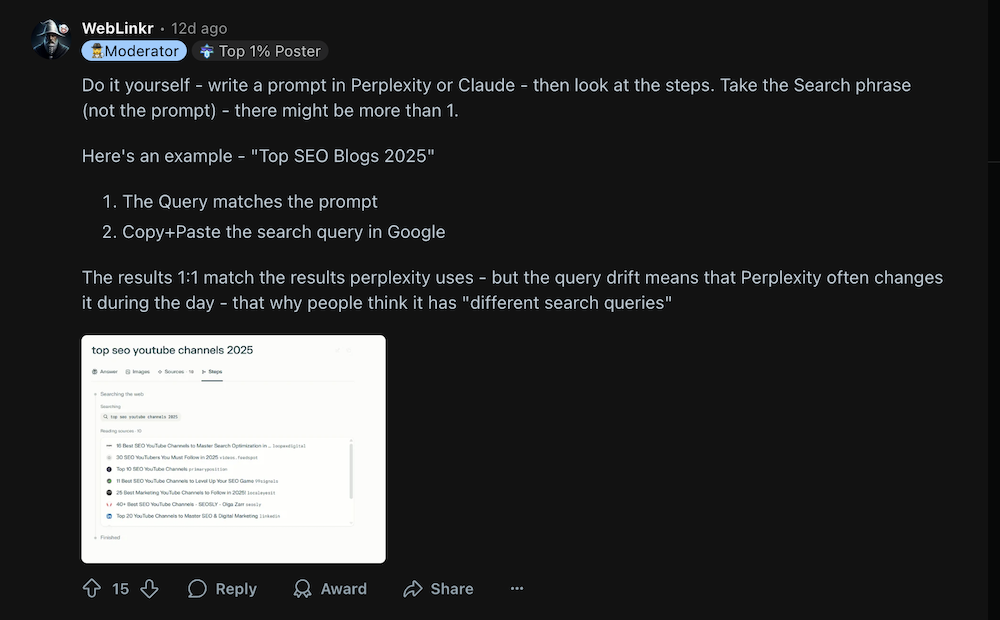
All this means is that, AI/LLM tools are simply doing a search, and compiling the data.
Which means, currently the best strategy for ranking on AI/LLM tools is to rank on Google Search.
And, likely, Google Maps will continue to play a bigger and bigger part of this for local searches.
That means, keep doing the positive SEO work listed from the ranking factors above and you’ll natural be ranking with AI/LLM search tools.
Wrapping Up Ranking Factors
It’s really important to know what ranking factors matter for local SEO. But, that being said, don’t get too lost in all the fluff and noise.
To me, it’s about the value of your money and time—that’s why I focus on doing the most effective tasks when it comes to ranking on Google.
It’s simply the 80-20 rule—focus on the 20% that gives you 80% of the returns—something I pay constant attention at Brightbeam SEO.
Because effort does not equal results, and all that matters in this game is getting results.
Now, let’s move on to the next topic in our local SEO guide: