


Performing a local SEO competitor analysis is always a top priority when starting any local business or SEO project.
Nothing exists in a bubble, and local SEO is a game of relativity. Your business rankings and goals can only be understood through one lens: the competitive landscape.
Without a concrete understanding of your competitors, you’re just guessing—and guessing will get you in trouble.
Let’s look at how to perform a competitor analysis, and what to look for, in order to strengthen your local SEO position and create a plan to win in your market.
Analyze Local SEO Competitors — What To Look For
There are many points of interest you can find from researching competitors, but when it comes to local SEO, you don’t want to get too lost in the weeds.
The primary goal here is to determine what competitors are doing that matters for local SEO, and where you can get an advantage over them.
Personally, I prefer to organize these data pieces onto a spreadsheet.
Here are the key competitor metrics to track for local SEO:
- Business Name
- Primary Category
- Secondary Categories
- City (Exact City of Address)
- Reviews # (Total)
- Review Velocity (Recent 1-Month)
- Domain Rating (Any Overall Domain Metric)
- Landing Page URL
- Title (Landing Page)
- H1
- H2 (First)
- Keyword 1
- Map Ranking (Any Ranking Metric)
- More Keywords
You can duplicate this spreadsheet I use for competitor research right here.
This gives you a really strong overall look at your competitors and what they are doing. That’s the goal here, have something simple that lets you review all of your top competitors with a simple snapshot.
And as you can see, most of these primary points of analysis match directly up with local SEO ranking factors — for obvious reasons.
This list also starts with Google Maps ranking factors, and then includes Google Search factors towards the middle.
You can also break this down further by creating a tab for top Maps competitors, top Search competitors, and even top AI/LLM competitors. That way, you can see who ranks well in each area, without getting confused.
With that, let’s reviews the most important elements from the list, and what to look for.
Business Name (Keywords)
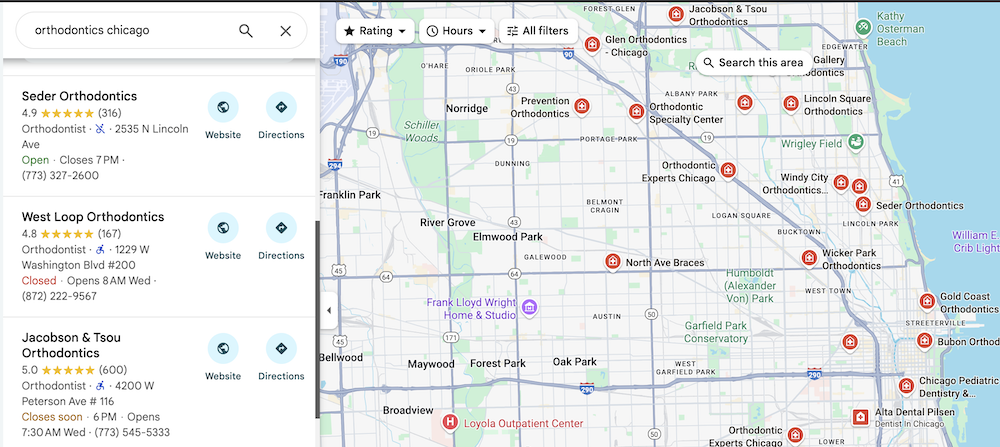
This list starts with factors directly related to Google Maps SEO rankings.
Starting with the business name.
And since keywords in your business name are such a heavy ranking metric and important part of Google Business Profile optimization, you want to analyze your competition and how many of them have keywords in their name.
Be aware of all the top ranking businesses, and the keywords they are using in their name to target specific searches.
Primary and Secondary Categories
Next, make a list of all the primary and secondary categories competitors are using.
If you offer multiple services — like gutters and electrical — research competitors in both of these areas and take notes.
You may even want to further break this list up into competitors in each major category.
Most importantly, this data will help you make sure you aren’t missing any categories for your business.
Reviews
With reviews and local SEO, there are many factors that play into how impactful they are. But for competitor analysis, it’s best to keep it simple.
Record the total number and then the number each competitor received over the last 1-month.
If you want, you can even make this the average over the last 3-months, if you want a more precise answer.
I find most high-ranking competitors don’t have a low review score, making this unnecessary to add.
Domain Rating & Authority Score
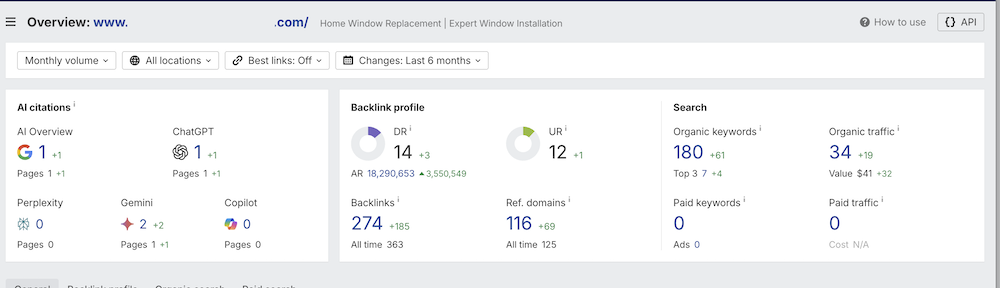
Tools like Ahrefs or others have their own authority, domain, or other measurements. These are not always reliable, but can give you a decent look at how strong competitors are.
However, recording any authority score metric can help give you a baseline to understand your competitors at a glance.
Backlinks
Similar to authority score, you can use tools to get a quick snapshot of competitor backlinks and gauge the amount of effort of investment required to win in local search.
Titles, Headers, Etc.
These metrics should be compared using the landing page URL only, or the direct page the competitor GBP is linked to.
That’s what matters.
With this information, you can see exactly what keywords your competitors are targeting. Are they using their brand name? The state? Or are they directly targeting your city and keyword, using an local SEO strategy—like for example “roofing company in city”.
This is important, and may give you some insight into why competitors are ranking well, and what they are trying to rank for.
Map Rankings
Lastly, it’s important to add any primary keywords you are ranking for, and where competitors are ranking for those keywords.
Then, you can use insights from this competitor research sheet to unpack important data.
Questions to Understand Competitor Data
Now that you have this information, let’s look at some of the most important questions to ask yourself, and see if you can find useful parallels to help improve your business rankings.
- Are they using the primary category keyword in their name?
- Do these businesses all share the same primary category?
- What about reviews? Do they have a high number of total reviews?
- Do they have high review velocity over the past month or few months?
- Do they have a high domain rating on average?
- Are they targeting keywords with their landing pages?
These are just a few important questions to ask yourself.
You can also paste this information into an AI tool like ChatGPT and ask for an analysis. This may help you find useful insights you may have missed.
Remember this, Google likes variety. So often, it will throw a few highly reviewed businesses in with potentially a lower reviewed one. This makes finding specific or direct ranking explanations difficult.
That’s why it’s important to use this as a general guideline and overview. There is no hard-fast rule here. Find what’s working generally and then go for it.
If you really want to grow, then it’s best to make a plan designed around outcompeting the top businesses, not simply matching the less competitive ones. If you’re behind in the race, you need to run faster than the guy in 1st place if you want to catch up.
Often times, the businesses ranking will differ from person to person, so don’t get too overwhelmed here. Understand good businesses do well on metrics, but also other variables you won’t see.
Use this to make a plan, and then go to work. No need to overthink it.
Competitor Analysis for Local SEO
This doesn’t need to be overly excruciating, this is meant to give you a general overview, make sure you don’t miss anything, and help you understand the pulse of your local market.
Find some helpful data, make a plan, and then revisit and update this sheet every quarter or so. This is something we do at Brightbeam SEO regularly.
With this finished, and all the other necessary data compiled, you’re in a great position to start optimizing your business, which is our next chapter in our guide to local SEO: